Read the Pitch
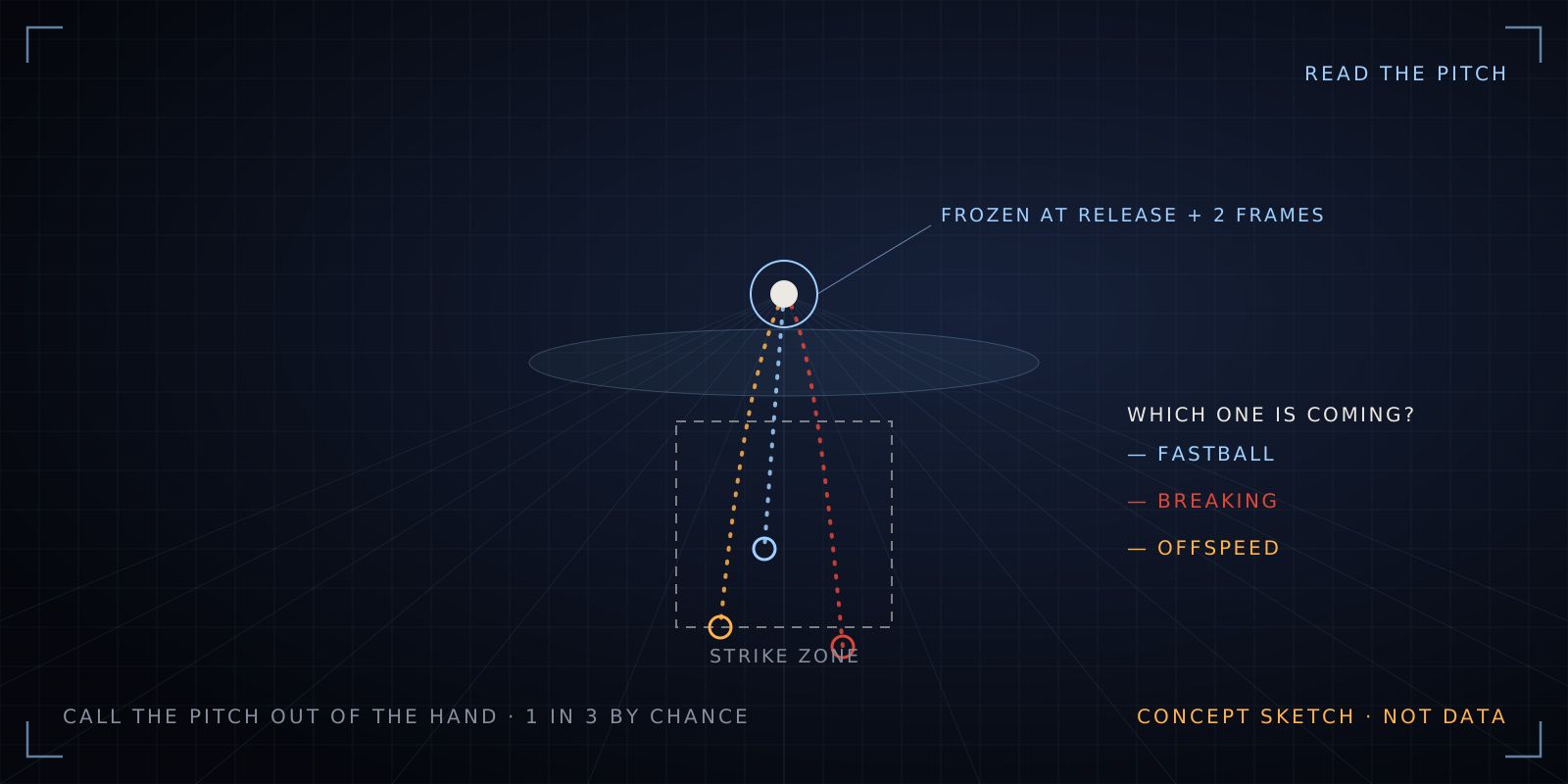
The sequel to Read the Swing. The video freezes just after release and you call fastball, breaking ball or offspeed, the way a hitter has to.
Builds on Read the Swing
- Coach questions
- 2
- Asked on air
- 9×
- Top question
- Q-15
Coach questions it could answer
The playbook →- Do unusual arm angles and deliveries make pitchers better?
Log every clip's arm angle and release point. If players misread pitches from low or unusual slots more often, that's direct evidence the delivery itself hides the ball, which is the case the hosts keep making for funky arm angles.
- Do pitchers throw their best pitches in the right spots?
Score each call against the pitch's location as well as its type. A pitcher whose best pitch is hardest to read when it's on the edge is throwing it in the right spot.
Data it needs
The data lake →1 of 2 on hand; the rest arrives in phase 2, Every pitch.
Could use later: Read the Swing plays
The question
Read the Swing asks whether you can tell where the ball is going from the swing. Read the Pitch flips it to the hitter’s side: from the pitcher’s release alone, can you tell what’s coming? A hitter gets well under half a second to decide. This would ask you to decide from a couple of frames.
How it would work
- Broadcast clips from the center-field camera freeze a couple of frames after release. You call fastball, breaking ball or offspeed.
- Every round has the same number of each, so guessing blindly scores exactly one in three, the same design that keeps Read the Swing honest.
- A no-video baseline plays alongside: knowing only the pitcher’s mix and the count. Beating that is the real test, just like the scouting report in Read the Swing.
First version
- 90 clips: 30 of each pitch group from 30 pitchers, 3 per pitcher, so no single arm decides the result.
- Freeze at release plus two frames, the same freeze logic and blind audit as Read the Swing.
- One results page: accuracy against chance and against the pitch-mix baseline, and accuracy by arm angle.
The data
Statcast pitch types, velocity, spin, arm angle and count for every pitch, with video from Baseball Savant. The Read the Swing clip pipeline (download, trim, review sheets, a blind audit) carries over almost unchanged.
What it needs
- Finding the release frame. Read the Swing finds contact from the sound of the bat. Release has no sound, so this needs a visual detector or a frame-by-frame review pass.
- Hiding the giveaways. The broadcast scorebug shows pitch speed and type right after the pitch, so it has to be masked or cropped.
- Fair pitch groups. Some pitchers’ pitches are obvious from arm angle alone; clips need balancing so a few pitchers don’t decide the result.
Status
An idea on the launchpad. Nothing is built yet.