Breakout Clock
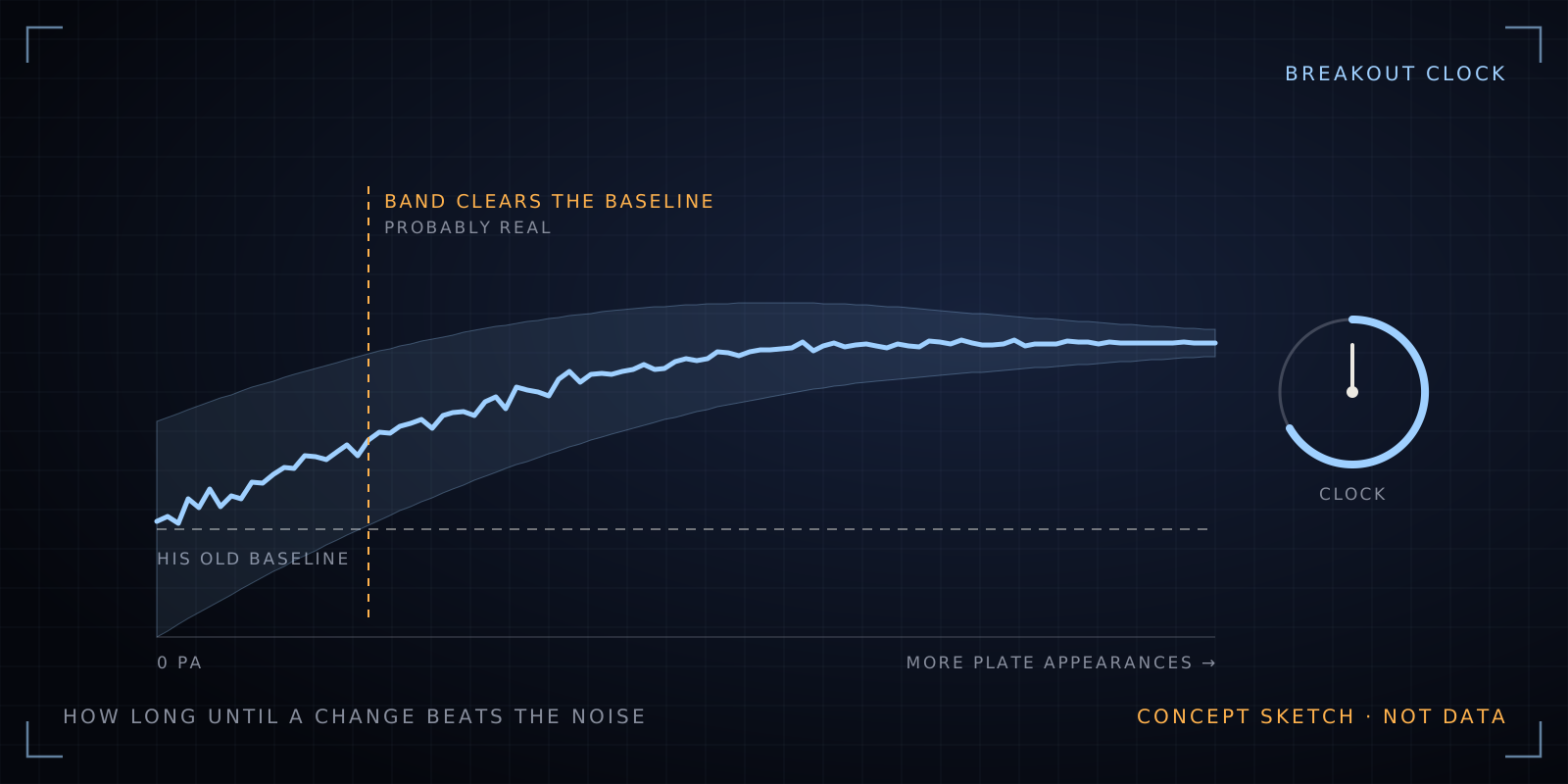
A hitter is raking. How many more plate appearances before you can believe it? The clock shows when a change in each stat beats the noise.
Builds on Answers for Coach
- Coach questions
- 3
- Asked on air
- 27×
- Top question
- Q-02
Coach questions it could answer
The playbook →- How fast can you tell a breakout or decline is real?
Pick any hitter and stat. The clock compares his rolling numbers with his prior baseline and shows how many more plate appearances it takes before the change is bigger than the noise for that stat.
- How much of a one-season split or rate stat is just noise?
The same math works for splits. Enter a day-night, home-road or versus-pitcher split and see whether the sample is big enough to mean anything yet.
- Which early-career signals predict a prospect's future?
Run the clock on rookies' first months to show which early numbers are already signal, like bat speed and chase rate, and which are still mostly noise, like batting average.
Data it needs
The data lake →1 of 2 on hand; the rest arrives in phase 1, The spine.
Could use later: Triple-A tracking
The question
After why teams beat or miss their expected record, the hosts’ most-asked question is some version of “is this real?” about a hot or cold hitter. Different stats settle at very different speeds: swing decisions and bat speed are trustworthy quickly, batting average and home run rate take far longer.
How it would work
- For each stat, estimate how fast it stabilizes from past seasons: how many plate appearances before a hitter’s number says more about him than about luck.
- For a given hitter, compare this season’s rolling number to his baseline and draw the uncertainty band around it shrinking as plate appearances pile up.
- The clock fills as the band pulls away from the old baseline. When it’s clear, the change is probably real.
First version
- Six stats chosen to span the range: chase rate, bat speed, strikeout rate, barrel rate, BABIP and home runs per fly ball.
- Any qualified hitter this season against his previous two.
- A plain-language verdict line under each stat.
The data
Statcast and MLB Stats API season and game data, 2015–26, using the Answers for Coach caches.
What it needs
- Stabilization estimates per stat, computed the same way for all of them and shown with their own uncertainty.
- Care with true changes in role or health. A hitter who changed his swing isn’t the same hitter, so the page should say what it can’t know.
Status
An idea on the launchpad. Nothing is built yet.